


Black-Scholes Model Explained
Black-Scholes estimates what an option could be worth in theory.
The formula estimates a theoretical option price based on stock price, strike, time to expiration, interest rate, and volatility. Time to expiration matters a lot: the less time remains, the faster time value decays and the more sensitive the contract becomes to small price moves. That is exactly why the model is useful for comparing contracts.
SIMPLE TRAFFIC-LIGHT SIGNALS INSTEAD OF RAW FORMULA OUTPUT
What this model actually does
In the Analyzer, we use the formula for valuation and derive the following information from it.
The strike sits far enough below the current stock price when measured against the expected move from volatility and time to expiration. At the same time, the estimated probability of finishing in the money stays low.
The strike still sits at an acceptable distance below the current stock price when measured against the expected move from volatility and time to expiration. The safety buffer, however, no longer looks especially large.
When measured against the expected move from volatility and time to expiration, the strike sits too close to the current stock price. The safety buffer is too small, and the probability that the option finishes in the money by expiration rises noticeably.
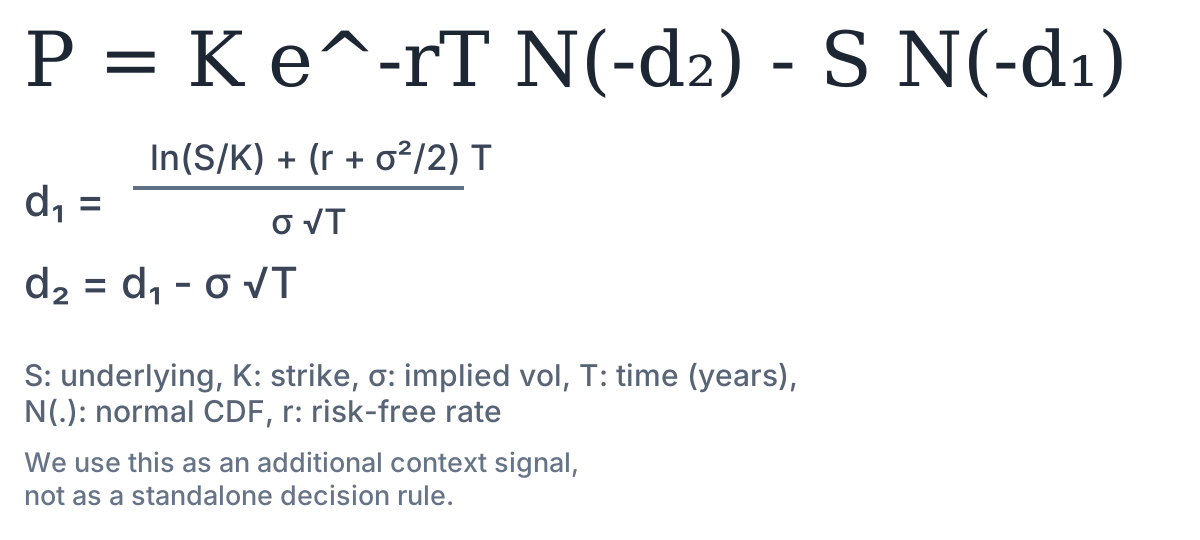
In the Analyzer, you do not need to calculate the formula yourself. We translate it into a clear green-yellow-red signal and read it together with liquidity, spread, and warnings.
Core input variables and what they mean
These are the standard Black-Scholes inputs used to estimate option value.
| Symbol | Input | Practical Role |
|---|---|---|
| S | Underlying Price | Current stock price level. |
| K | Strike Price | Contract strike used for payoff calculation. |
| T | Time to Expiration | Remaining time window for value decay and uncertainty. |
| r | Risk-Free Rate | Discounting baseline in theoretical pricing. |
| sigma | Volatility | Expected price variability; key driver of option value. |
| N(d1), N(d2) | Normal Distribution Terms | Probability-weighted components inside the formula. |
Example setup
This sample setup shows how the relationship between price, strike, time, and volatility is interpreted in practice.
| Stock price | $100 |
| Strike | $90 |
| Time to expiration | 30 days |
| Implied volatility | 25% |
In this example, the stock trades at $100 and the strike is at $90. That means the distance to the strike is $10. With 30 days to expiration and 25% implied volatility, the expected move is roughly $7.
If that expected move stays clearly smaller than the distance to the strike, the setup tends to look green. If the expected move starts getting close to the strike, it shifts toward yellow. If the expected move eats up too much of that buffer, the setup can turn red.
In this example, the setup looks more green because the $10 distance to the strike is larger than the roughly $7 expected move.
The classic Black-Scholes model simplifies the option as if it remains open until expiration. U.S. equity options, however, can be exercised earlier. For a short put, that means shares can be assigned to you before expiration. For our use here, that is mainly a theoretical limitation because we use Black-Scholes for valuation before selling the put. What happens later in practice around assignment and position handling is treated separately.
FAQ
What does the Black-Scholes formula calculate?
It estimates a theoretical option price based on stock price, strike, time to expiration, interest rate, and volatility.
Why is volatility so important?
Volatility strongly influences the expected move. Higher volatility usually means more option value and more pressure on nearby strikes.
Why does the Analyzer show a traffic-light signal instead of raw formula output?
Because most users need a fast practical interpretation. The signal condenses the volatility context into an easier first read.
Why can a setup still be risky even if Black-Scholes looks acceptable?
Because Black-Scholes only covers part of the evaluation. Liquidity, spread quality, events, assignment logic, and portfolio fit are checked separately in the Screener and Analyzer and still need to be read alongside it.