


Black-Scholes Options Model
Black-Scholes is a useful starting point for option pricing, but it is not enough on its own to make a full trade decision. This guide shows how to use it in a risk-first workflow.
What you will learn in 30 seconds
- What the Black-Scholes formula estimates in practical terms.
- How each input changes option value and risk context.
- How to combine model output with liquidity, warnings, and portfolio limits.
Quant Baseline, Not Autopilot
Use the model as a structured reference
The formula gives a theoretical value based on fixed assumptions. In real trading, your fill price and total risk still depend on market conditions and your portfolio setup.
- Treat model value as orientation, not as a guaranteed fair price.
- Use implied volatility context before interpreting mispricing.
- Always validate with spread, volume, open interest, and warning signals.
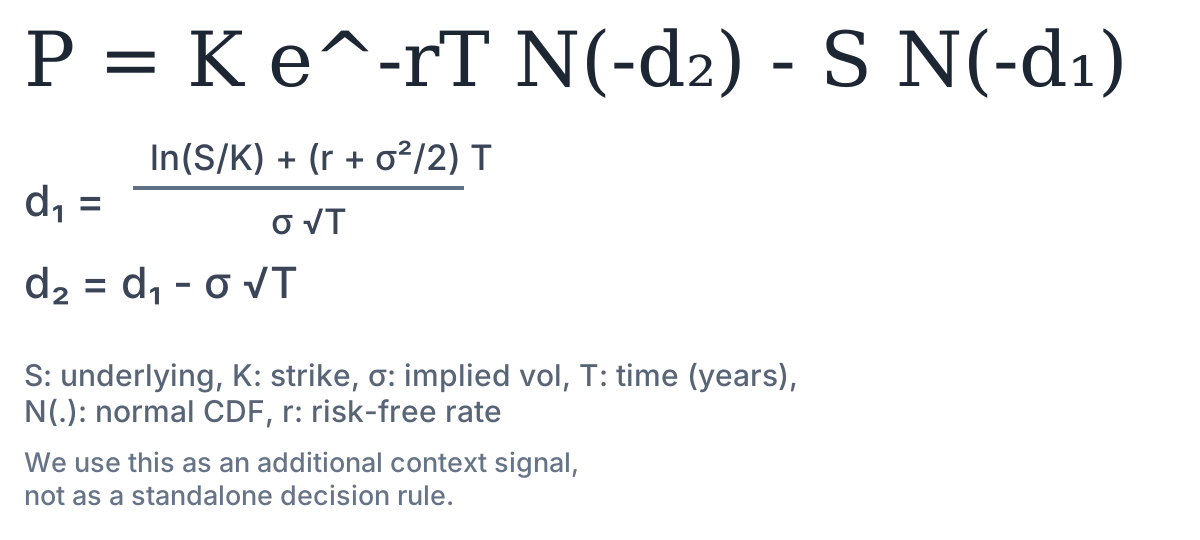
Core input variables and what they mean
These are the standard Black-Scholes inputs used to estimate option value.
| Symbol | Input | Practical Role |
|---|---|---|
| S | Underlying Price | Current stock price level. |
| K | Strike Price | Contract strike used for payoff calculation. |
| T | Time to Expiration | Remaining time window for value decay and uncertainty. |
| r | Risk-Free Rate | Discounting baseline in theoretical pricing. |
| sigma | Volatility | Expected price variability; key driver of option value. |
| N(d1), N(d2) | Normal Distribution Terms | Probability-weighted components inside the formula. |
1. What the model is good at
Black-Scholes is strongest as a consistent comparison framework.
- It helps standardize relative pricing across similar contracts.
- It gives a common language for sensitivity (Greeks, e.g. delta) and volatility.
- It improves decision consistency when used with fixed portfolio rules.
2. What the model does not capture well
Real markets violate key model assumptions regularly.
- It assumes stable volatility and smooth return behavior, which often breaks in stressed markets.
- It does not model execution problems like wide spreads and bad fills.
- It does not replace event-risk checks (earnings, macro shocks, company-specific news).
3. How to use it inside this product
Keep model output as one component of a larger risk process.
- Use Screener to pre-filter weak setups before model-focused review.
- Use Analyzer Engine to read signal context and warning concentration.
- Use Portfolio Planner so a mathematically attractive trade does not create too much concentration risk.
Practical interpretation scenarios
Setup: Theoretical value suggests favorable pricing, but spread is wide and open interest is thin.
Interpretation: Execution risk can remove the model advantage; the expected edge may not be achievable in real trading.
Next Step: Prefer higher-liquidity alternatives with slightly lower theoretical edge.
Setup: The contract looks fairly priced, with stable liquidity, acceptable warnings, and manageable exposure impact.
Interpretation: This is where Black-Scholes adds value: supporting a disciplined, repeatable decision.
Next Step: Proceed only after final portfolio concentration check.
Common model-usage mistakes
- Using theoretical value as a standalone entry signal.
- Ignoring changes in implied volatility when comparing contracts.
- Treating model precision like certainty in event-driven markets.
- Skipping portfolio-level checks because one contract looks mathematically attractive.