


Wheel Strategy Screener
The wheel strategy is an options strategy in which you use cash-secured puts and covered calls to collect premiums regularly and build an additional stream of passive income, as long as you are willing to buy and hold suitable stocks when needed.
The wheel strategy combines cash-secured puts and covered calls to generate option income around stocks you would generally be willing to own.
The most important part of the wheel strategy is entering through the right cash-secured put.
That is where many of the best and worst decisions happen. If you choose the put carefully, you start the wheel strategy with more control, a clearer plan, and often less stress.
If you are searching for a wheel strategy screener, you usually want one thing above all: suitable stocks, cleaner cash-secured put setups, and a more structured entry into the wheel strategy.
The strategy itself is easy to understand. The harder part is usually applying it in practice: Which stock is actually a good fit? Which put looks attractive not only because of the premium, but also because of the risk? And how will a new put affect the overall portfolio later on? That first and most important step of the wheel is exactly where we specialize.
Before a put setup even appears in the screener, our algorithm has already done a lot of the groundwork for you: from narrowing down many possible candidates to a basic fundamental review with key company data, technical analysis, liquidity analysis, tradability checks, additional option assessment, and clearly visible warning signals.
What is the wheel strategy?
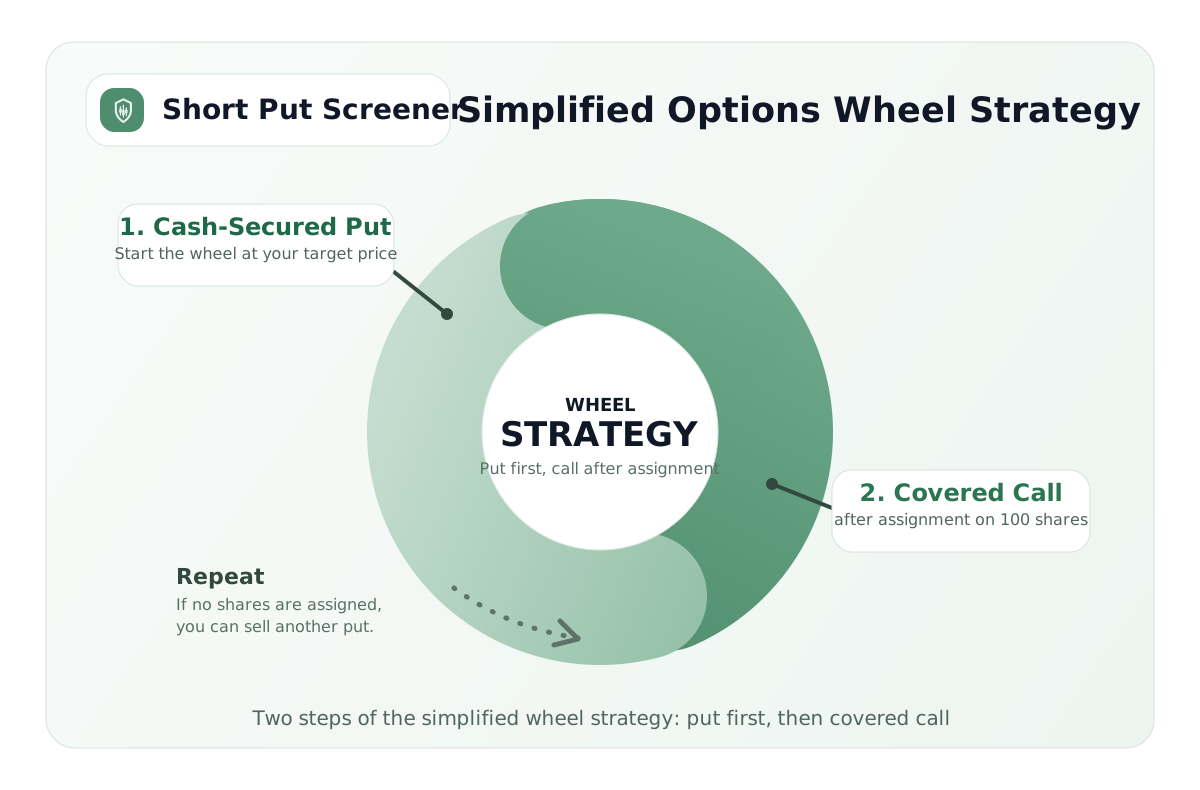
The simplified wheel strategy consists of two simple steps that can repeat over and over again.
1. You sell a put on a stock that you would genuinely be willing to own.
2. If the stock is assigned to you, you sell a covered call on those shares.
If assignment does not happen, you keep the premium and can sell another put later. If shares are assigned to you, you move into the covered-call part of the strategy.
That is why it is called a "wheel": the process can repeat in a circular way.
Are You Ready for the Wheel Strategy?
This readiness test lets you check whether you understand the wheel strategy not only in theory, but also in the practical decisions around assignment, capital commitment, strike selection, liquidity, and portfolio fit.
This test is intentionally not just a knowledge quiz. It is a practical check for the most common thinking mistakes and execution risks inside the wheel strategy.
It tests whether you understand cash-secured puts, assignment, strike logic, capital commitment, liquidity, portfolio fit, and process discipline well enough to not only explain the wheel, but apply it cleanly in practice.
- Do you really understand the combined flow of cash-secured put, assignment, and covered call?
- Can you distinguish between attractive premium and real risk?
- Do you account for capital commitment, contract size, and possible assignment from the start?
- Do you place delta, break-even, liquidity, and event risk into the right context?
- Do you review new wheel trades for position size, sector concentration, and portfolio interaction as well?
- Do you work from a repeatable process or mainly from impulse and premium chasing?
Why the wheel strategy is also called triple income
The wheel strategy is sometimes also referred to as the Triple Income Strategy. The reason is that up to three different income sources can come together throughout the process.
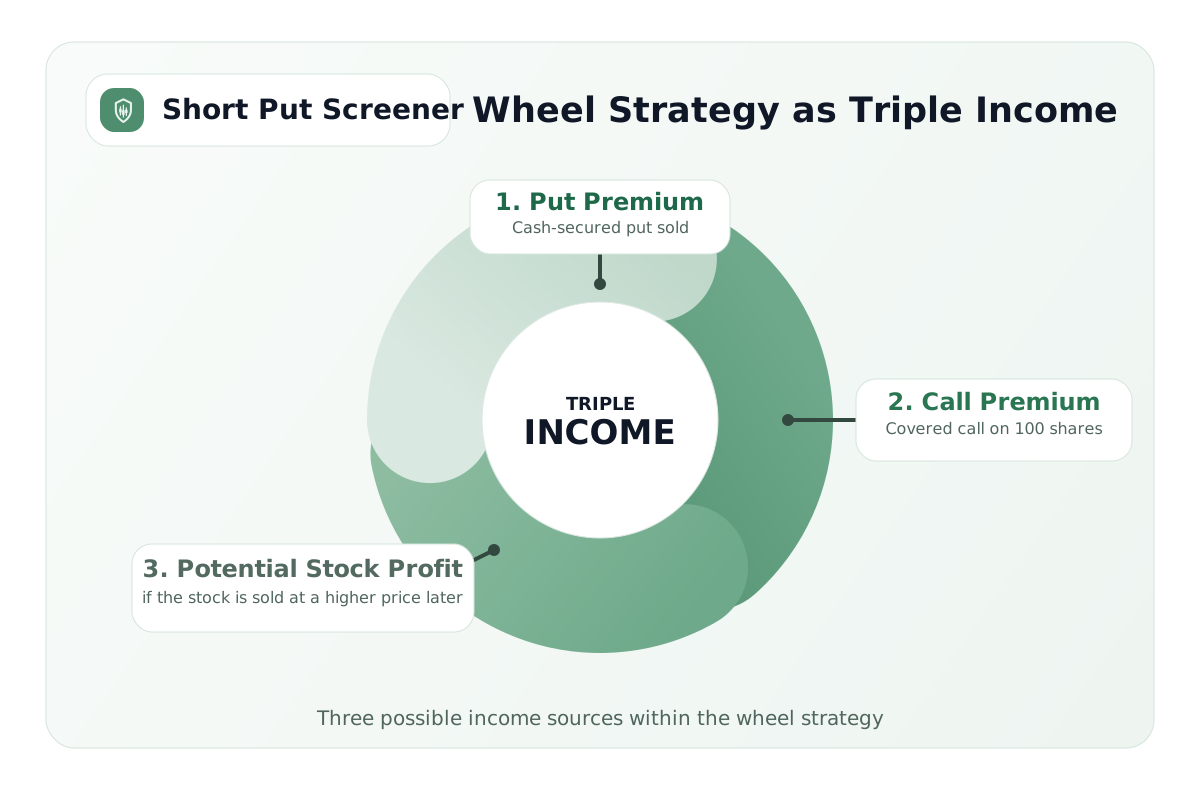
- Put premium: You collect the first premium when you sell the cash-secured put.
- Call premium: After assignment, you can collect additional premiums by selling covered calls.
- Potential stock profit: If the stock is later sold above your entry price or above the call strike, an extra gain from the stock move can be added.
Why the put is the most important step
Many explanations of the wheel strategy move to the covered call very quickly. In our view, that leaves out the most important part. The most important step is the cash-secured put at the beginning.
Put differently: if you sell a bad put on a bad stock, the rest of the wheel often becomes difficult. If you sell a good put on a stock you actually want to own, the next phase becomes much easier too.
This is exactly where our strength lies. We do not just explain the wheel strategy in general. We help you execute the most important step more cleanly: choosing a suitable cash-secured put.
- This is where you decide which stock you may have to buy.
- This is where you define the price at which you would be willing to buy it.
- This is where you decide how much premium you collect.
- This is where the risk begins if the stock price falls sharply later.
- With the Screener, you structure the shortlist.
- With the Analyzer, you review quality and warnings.
- With the Planner, you see whether the trade fits your portfolio at all.
How to find suitable stocks and put setups faster
The biggest challenge is often not the theory, but the selection process. There are many stocks, many expiration dates, and many possible puts. If you search everything manually, you quickly lose time and perspective.
This matters especially for wheel users. The better the preselection, the lower the chance that you drift into a weak setup only because the premium looks attractive. At the same time, you save time when searching for suitable wheel strategy stocks.
With two simple sliders in the screener, you define which setups fit you: annualized return in percent and risk via delta.
- It saves time during selection.
- It reduces information overload.
- It adds structure to the shortlist.
- It uses an AI-optimized algorithm to surface relevant candidates faster out of many possible choices.
- It helps you identify the relevant put setups faster across the broad US options market.
Important for beginners: 1 put means 100 shares
One put or call contract refers to 100 shares.
That is exactly why the first step is called a cash-secured put.
Cash secured means that you already keep the required cash available before selling the put.
You do not reserve the cash because you are certain you want to buy. You reserve it because by selling the put, you accept the obligation to buy if assignment happens.
- If you sell 1 put, you take on the obligation to buy 100 shares if assignment happens.
- If you sell 2 puts, it can mean 200 shares.
- You sell 1 put with a 95 USD strike.
- One contract stands for 100 shares.
- That means you must reserve 100 x 95 USD = 9,500 USD for possible assignment.
How the wheel strategy starts in practice
For beginners, a clean start usually looks like this.
Important: selling a put is not a trick for quick money. It is more like a planned buying attempt with a premium attached.
If you want to buy a stock below the current market price, you can intentionally choose a put where assignment is more likely. If your focus is more on repeated premium collection, you will usually choose delta more conservatively.
- You look for a stock that you would be comfortable owning over time.
- You choose a put strike where you would be happy to buy the stock.
- You keep enough cash ready to buy 100 shares.
- You collect the put premium.
- You wait to see whether the put expires worthless or whether you are assigned.
Our workflow for wheel users: select, analyze, diversify
We do not look at the wheel strategy as just an explanation. We look at it as a workflow.
With the Screener, you narrow down suitable put candidates faster instead of having to work through endless data manually.
With the Analyzer, you check whether a contract not only looks attractive, but also makes sense from a quality perspective.
This lets you evaluate a put in a more structured way.
- We do not look only at return.
- We make warning signals visible.
- We translate more complex metrics into clearer signals.
With the Planner, you can see how new puts, existing stock holdings, and running covered calls affect your portfolio together.
This matters especially when you do not just have one single trade, but several open positions planned or already held in the portfolio. Many people think about the wheel strategy only in terms of one put or one covered call.
For active wheel users with several positions, this is a major advantage. A good single put can still be a poor fit for the total portfolio. The Planner makes that risk visible.
This becomes even more valuable when you want to balance several sectors properly. It is not just the number of positions that matters, but also how your capital is distributed across sectors. This is where sector allocation and ETF sector allocation help make your true portfolio exposure visible. That turns one wheel idea into a better portfolio decision.
In addition, the Planner can automatically calculate a portfolio proposal from screener candidates through a simulation. You control it live with your target return and maximum risk settings via delta. That way, you do not just get isolated ideas, but a more structured proposal for a possible add-on portfolio and can see how multiple new positions work together.
You can export this planning view to document your current thinking and target portfolio more clearly.
- you may already hold stocks
- you may already have running covered calls
- you may want to add new puts
- the Planner makes diversification visible
- it shows concentration risk
- it makes capital usage visible early
- it shows sector allocation in the current and add-on portfolio
- it also accounts for ETF sector allocation, because ETFs can include several sectors at once and make portfolio classification more complex
- it helps you understand how stocks, covered calls, and new puts work together
What happens if 100 shares are assigned to you?
If the stock price is below your put strike at expiration, it can happen that 100 shares are assigned to you. That is not a failure of the strategy, but a normal part of it.
From that moment on, you own the stock. Then the second part of the wheel begins: you can sell a covered call on those 100 shares.
For beginners, there are two simple ways to handle that.
If the stock was assigned to you at the put strike, you can sell a call at exactly that same price.
This fits well if you want to keep the process simple and rule-based.
- you collect another premium
- if the shares are called away, you exit again at your assignment price
- the wheel logic stays simple and repeatable
If you believe the stock could still rise in the short term, you can choose a higher call strike.
Important: if you sell a call below your original put strike and the stock rises to that call strike, you collect the premium but sell your shares at a capital loss.
- you also collect a premium
- if the stock rises and gets called away, you can also capture additional stock gains
- the call premium is often smaller than at a strike right at the assignment level
What if the stock falls sharply after assignment?
Sometimes an assigned stock falls so much that a covered call at the original assignment strike brings little premium or no longer makes sense at all.
In that situation, one important rule applies: you do not have to force the wheel to continue immediately at any price.
For beginners, there are usually three simple choices in that situation.
If the price sits far below your assignment level, it can make sense not to sell a covered call for now. That gives the stock time to recover and gives you time to reassess the position calmly.
Useful questions to ask yourself are:
- Would I still want to own this stock today at this price?
- Was the drop just normal market noise, or has the underlying quality deteriorated?
- Do I want to sell calls again later, or would I rather exit the position completely?
- you avoid selling a call at an unattractive strike
- you give the stock time to recover
- you do not force the next decision under pressure
- you do not collect a new call premium during that time
This is possible if you consciously accept that the shares may be sold at a realized loss.
- you still collect premium again
- you have a clear exit plan
- if the stock rises above the call strike, you can be called away at a realized loss
If your view on the stock has changed, a clean exit can be the best solution.
- you end the risk
- you stop tying up capital in a position that no longer fits your plan
- the loss is realized immediately
Simple wheel strategy example
Let us take a stock that is currently trading at 100 USD.
- You sell a put with a 95 USD strike.
- You receive a 3 USD premium per share.
- One contract refers to 100 shares.
- That means you collect 300 USD immediately.
If the stock stays above 95 USD, the put expires worthless.
- you keep the 300 USD
- you do not buy any shares
- you can sell the next put later
If the stock falls below 95 USD, 100 shares are assigned to you at 95 USD. Your effective entry improves because of the premium already received.
- purchase price: 95 USD
- received put premium: 3 USD
- effective entry: 92 USD
You now own 100 shares with an effective entry of 92 USD.
If the stock is above 95 USD at expiration and you sell a covered call with a 95 USD strike for a 2 USD premium, the result looks like this.
- your 100 shares are sold at 95 USD
- stock gain versus the effective entry: 3 USD per share
- call premium: 2 USD per share
- total gain in this phase: 5 USD per share or 500 USD
- including the first put premium, total profit becomes 800 USD
If you instead sell a covered call with a 100 USD strike for a 1 USD premium, the result looks like this.
- your 100 shares are sold at 100 USD
- stock gain versus the effective entry: 8 USD per share
- call premium: 1 USD per share
- total gain in this phase: 9 USD per share or 900 USD
- including the first put premium, total profit becomes 1,200 USD
- A call at the same strike is often simpler and usually brings a bit more recurring premium.
- A higher strike usually brings less premium, but leaves more room for additional stock gains.
- If you want to keep the process simple, rent out the call at the assignment strike.
- If you want to leave the stock more upside room, choose a higher strike.
Advantages of the wheel strategy
- You collect premium already at the entry stage.
- You do not buy stocks blindly at market price, but at a planned target price.
- After assignment, you can collect additional premiums with covered calls.
- The process is clear, repeatable, and easier to understand than more complex strategies.
Typical mistakes
- focusing only on high premiums
- choosing stocks you do not really want to own
- selling the put without a clear plan
- looking only at one contract and ignoring the portfolio context
Who is the wheel strategy suitable for?
The wheel strategy is most suitable for you if:
It is usually less suitable if:
- would gladly buy suitable stocks at lower prices anyway
- like the idea of recurring premiums, extra rental-style income, and passive income
- prefer a simple and structured process
- are willing to take ownership of 100 shares per option contract
- do not want to be assigned shares at all
- are looking for very fast, heavily leveraged trades
- do not have a clear plan for position sizing and risk
Why risk should not be measured by premium alone
A high premium sounds attractive. But a high premium alone does not make a put good.
That is why a put should never be selected based on one number only.
This is where our Analyzer helps with a clearer quality review. It supports you in looking at return, warnings, and overall contract quality together instead of in isolation.
- more return also means more risk
- attractive-looking setups can still have weaker quality
- one good-looking metric is not enough if the rest of the signals point the wrong way
Frequently asked questions about the wheel strategy
What exactly does the wheel readiness test check?
The test does not just check terminology. It mainly checks whether you can interpret the practical logic of the wheel strategy correctly: assignment, capital commitment, strike selection, liquidity, risk, and portfolio fit.
That makes it more of a practical self-check for wheel users than a pure theory quiz.
How many questions are included in the wheel readiness test?
The test pulls up to 12 questions from the topic areas you selected. That keeps the flow compact while still letting you cover basics, assignment, risk, execution, portfolio fit, and mindset in a targeted way.
Is the wheel strategy suitable for beginners?
Yes, but only if the start with the put is truly understood. The easiest entry is not to trade as many options as possible, but to focus on a few clear setups on stocks you would actually be willing to buy.
Is the wheel strategy good for passive income?
Many people use the wheel strategy to build recurring income through premiums. Put simply, it can be compared to rental income because you collect recurring premiums through puts and covered calls.
Even so, the strategy still involves risk and only works well when stock selection and risk management are both handled properly.
What is more important: the put or the covered call?
The put is more important. That is where you define the stock, purchase price, risk, and starting premium. The covered call is the follow-up process after that.
Why is a wheel strategy screener useful?
Because the quality of the wheel is usually decided before the first trade ever happens. The screener helps you find better stocks and better put setups instead of just chasing high premiums.
Our screener also supports that shortlist with an AI-optimized algorithm so you reach the most relevant candidates faster.
How do I find good stocks for the wheel strategy?
Suitable wheel strategy stocks are usually stocks you would genuinely want to own if assignment happens.
What matters is not just premium and return, but also risk, quality, liquidity, and whether the position still fits your overall portfolio.
What does the Analyzer add for the wheel strategy?
The Analyzer helps you review a put not only by return, but also by quality, warning signals, and overall setup context. That lets you validate setups more systematically.
Why is the Planner important for the wheel strategy?
Because a good single trade can still be a poor fit for the total portfolio. The Planner helps you see how existing stocks, covered calls, and new puts affect diversification, sector concentration, and capital usage together.
What is better: a covered call at the same strike or at a higher strike?
A covered call at the same strike is usually simpler and often brings a bit more ongoing premium. A higher strike usually brings less premium, but leaves you more room for extra stock gains.
Which version fits better depends on whether you mainly want simpler rental-style income or a bit more upside potential.
What happens if the stock falls sharply?
Then you can still end up at a loss despite the premiums, because you may have to take over the stock at a higher price than it is currently worth. That is exactly why stock selection is so important.
Conclusion
The wheel strategy is easy to understand, but success depends heavily on the first step. That is exactly why it makes sense to choose the put in a structured way instead of selecting it by premium alone.
Our approach is clear: Select with the Screener, analyze with the Analyzer, and diversify with the Planner.
If you want to not only understand the wheel strategy but implement it better, you need more than a general explanation. You need a clear workflow for selection, analysis, and diversification.
Next, go deeper on cash-secured put strategy, covered call vs cash-secured put, and how to select put strike.